
Not every herding instinct test uses sheep. Many clubs and private evaluators run tests on ducks, a few run on goats, and some offer cattle for dogs with the temperament and size to work large stock. For owners preparing a dog for a first Herding Instinct Certificate (HIC) test, the livestock species available at the local test site matters more than most handlers realize. Ducks and sheep elicit different behavioral responses from both the livestock and the dog, and the evaluator interprets those responses against species-specific benchmarks. Understanding the differences helps owners prepare realistic expectations and choose the species best suited to their dog’s first exposure.
How the Livestock Responds
Sheep and ducks behave very differently under pressure from a herding dog. Understanding the livestock response pattern is the foundation for understanding what the evaluator is actually measuring.
Sheep flock tightly when approached by a stalking predator. A small group of three to five sheep will typically bunch and move as a unit, away from the dog’s pressure. Their reaction speed is moderate, their flight distance is substantial (10 to 30 feet depending on the sheep’s dog-experience), and they take substantial handler-directed pressure before they will move in a tight space. This behavior produces a test environment where a dog with moderate drive and average confidence can develop a workable rhythm.
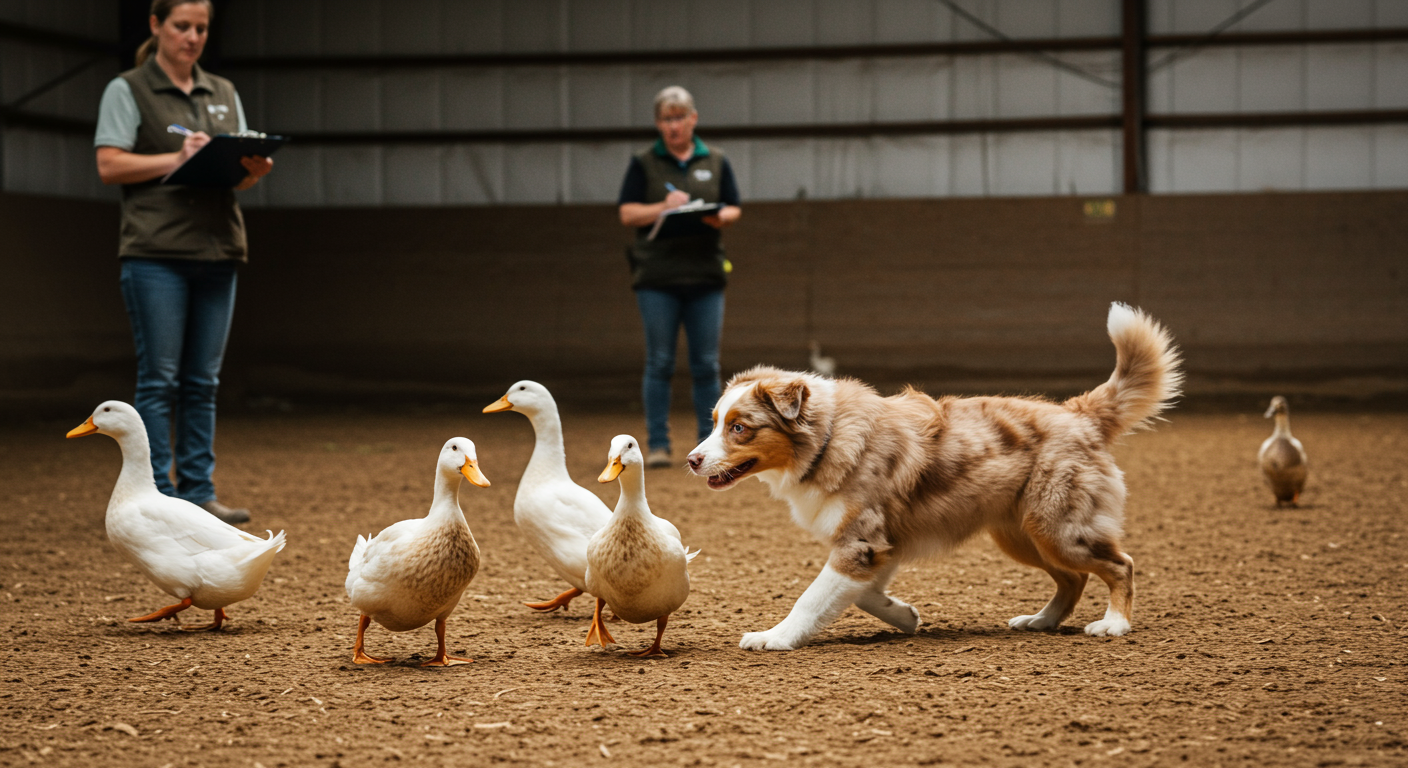
Ducks flock more loosely and move faster. Indian Runner ducks are the most commonly used species for HIC testing because they move in a coordinated group, respond to pressure promptly, and are small enough to be non-threatening for first-test dogs. Their flight distance is shorter (typically 5 to 15 feet), and they reset quickly after the dog applies pressure. This creates a test environment where the dog sees immediate cause-and-effect between movement and livestock response.
Goats, where offered, behave with more individual independence than sheep and less cohesion than ducks. They are less commonly used for formal HIC tests because the coordinated group response is harder to establish with goats than with sheep or ducks.
What the Dog Typically Shows on Each Species
A dog’s behavioral response differs meaningfully by species. On sheep, most dogs with moderate instinct show the classic circling pattern, eye, stalking approach, and pressure-release cycle within the first 10 to 30 seconds. The sheep’s cohesive response gives the dog clear feedback, and the test quickly reveals whether the dog is comfortable applying and releasing pressure.
On ducks, some dogs initially chase rather than herd. The rapid duck response can trigger prey-drive behavior in dogs who would show cleaner herding work on sheep. Other dogs find ducks easier because the smaller stock is less intimidating for a dog that has never seen livestock before. Very young or very tentative dogs often show better instinct on ducks first because the lower pressure level from the livestock lets the dog engage without being overwhelmed.
The evaluator is trained to distinguish prey-drive chasing from genuine herding behavior, and the judging criteria account for species-specific presentations. A dog pronounced “passed” on ducks has shown evidence of herding intent specifically — circling, pressure-release, showing eye or approach pattern — not merely prey pursuit. For the broader picture of what evaluators look for, the reading body language guide covers the behavioral signals that distinguish real instinct from chase behavior.
When Ducks Are the Better First Choice
Ducks are often the better species for a first HIC test in several specific circumstances:
- Very young or small dogs. Sheep can be intimidating or physically risky for a small or very young dog. Ducks present lower risk.
- Tentative or handler-oriented dogs. Dogs who hesitate with sheep sometimes engage cleanly with ducks because the smaller stock triggers less avoidance.
- First-exposure dogs with no livestock history. Ducks provide a gentler introduction to the concept of moving stock.
- Dogs of breeds that work ducks traditionally. Australian Shepherds, Corgis, and a few other breeds have working histories that include smaller stock.
However, ducks have some limitations. Dogs with very strong herding drive sometimes pass on ducks but then struggle when transitioning to sheep because the pressure dynamics are different. A dog passing HIC on ducks should not be assumed ready to work sheep without additional preparation.
When Sheep Are the Better First Choice
Sheep are often the better species for a first HIC test when:
- The dog is a Border Collie, Kelpie, or strong-eyed herding breed. These dogs typically show their cleanest work on sheep and may over-drive ducks.
- The dog will eventually compete in traditional sheepdog trials. Starting on sheep from the first test aligns the dog’s exposure with its long-term trial career.
- The dog is large enough and physically capable of pressuring sheep safely. Mature dogs with good size can work sheep without the injury risk smaller dogs face.
- The evaluator and facility are sheep-oriented. Some evaluators are substantially more experienced with sheep than ducks, and the evaluator’s experience affects the quality of the test.
A Species Comparison Checklist for Handlers
| Consideration | Ducks | Sheep |
|---|---|---|
| Livestock flight distance | 5–15 feet | 10–30 feet |
| Response speed | Fast | Moderate |
| Injury risk to dog | Low | Moderate |
| Injury risk to stock | Moderate | Low |
| Best for very young dogs | Yes | No |
| Best for Border Collies | No | Yes |
| Best for strong-eyed dogs | No | Yes |
| Best for small breeds | Yes | Varies |
| Typical session duration | 5–10 minutes | 5–15 minutes |
What Happens if the Dog Passes on One Species but Not the Other
Most HIC programs treat a pass on ducks as equivalent in principle to a pass on sheep — the certificate reflects that the dog demonstrated herding instinct. Some breed clubs, however, weight sheep passes more heavily when evaluating breeding stock because sheep work is the traditional standard for most herding breeds. Handlers planning to use HIC results in a breeding program should check the specific expectations of their breed club.
A dog that passes on ducks but fails on sheep sometimes needs additional confidence-building before a second sheep attempt. A dog that passes on sheep but struggles with ducks usually does not need remedial work — the pressure dynamics are different enough that a sheep pass demonstrates the underlying instinct conclusively. For handlers whose first test did not go well, our retesting after failure guide walks through the assessment and preparation for a retry.
Preparing Your Dog for the Livestock Species at the Test
The specific species at the test location should influence the dog’s pre-test preparation. For a duck test, practice in close-quarters arenas with smaller obstacle fields if possible. For a sheep test, look for a training facility that offers a practice session on sheep before the formal HIC date. Our preparing your dog for the first HIC guide walks through the preparation week in detail.
The broader point is that the livestock species is not a minor detail. It shapes the behavioral expression of the instinct and the feedback the dog receives during the evaluation. Handlers who choose the species thoughtfully and prepare accordingly have higher pass rates and, more importantly, better behavioral outcomes for their dogs regardless of whether the dog ever competes in formal trials.