
A failed HIC test is rarely a referendum on the dog. It is almost always a referendum on the match between the dog’s developmental stage, the evaluator’s setup, and the handler’s preparation. Dogs that fail their first attempt frequently pass on the second or third try without any change to their underlying instinct — what changed was the context. Understanding why a particular dog did not pass is the first step to building a retraining plan that actually addresses the right issue. Blanket advice to “do more practice” is not useful. Targeted advice that matches the failure pattern is.
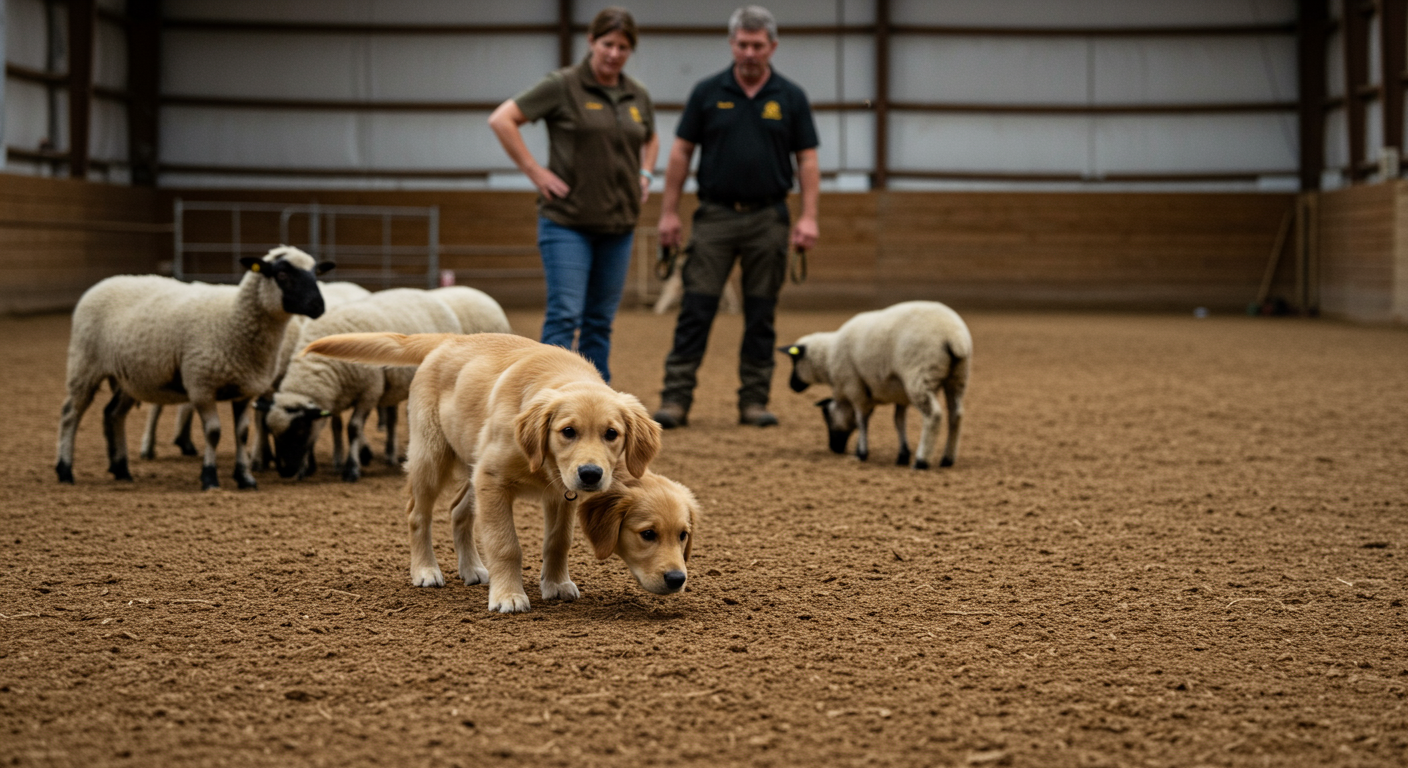
The Four Common Failure Patterns
Most HIC failures fall into one of four patterns. Each requires a different response.
Pattern 1: Shut Down
The shut-down dog enters the arena, sees the livestock, and mentally disconnects. The dog may sniff the ground, move toward the handler, focus on the evaluator, or simply stop moving. The instinct is probably present but is being suppressed by overwhelm, nervousness, or unfamiliarity with the environment.
Diagnostic features include: tail tucked or low, avoidance behavior rather than engagement, handler-focus rather than livestock-focus, and typical calming signals (yawning, lip-licking, slow movement). The dog is not afraid of livestock specifically; the dog is overwhelmed by the composite stimulus of new environment, evaluator, handler anxiety, and unfamiliar animals.
Retraining plan: More environmental exposure, not more livestock work. Visits to the test facility without livestock, calm spectating of training sessions, pairing the environment with positive routine. Only after the dog is comfortable in the environment should livestock exposure resume. Our preparing your dog for the first HIC guide covers the full pre-test environmental preparation.
Pattern 2: Over-Chase / Prey Drive
The over-chase dog engages livestock enthusiastically but as prey rather than as stock. The dog pursues rather than pressures, bites or nips rather than flanks, and does not show the pressure-release cycle that distinguishes herding from predation. Evaluators are trained to fail this pattern because the behavior is welfare-damaging to the stock and does not demonstrate herding intent.
Diagnostic features include: direct approach lines rather than circling, mouthing or gripping, no softening of approach when livestock yield, and continued pursuit after the livestock stop moving. This pattern is more common in high-prey-drive dogs without herding heritage, in young dogs with strong drive but no training framework, and in dogs from working lines bred for coursing or vermin work rather than herding.
Retraining plan: Structured introduction to livestock pressure through barriered exposure, leash-work near livestock without direct access, and gradual progression to off-leash under the close supervision of an experienced handler. For many over-chase dogs, formal training with a professional herding instructor is the fastest path forward. Our common mistakes handlers make guide addresses the handling errors that often compound prey-drive issues.
Pattern 3: Soft / Under-Confident
The soft dog approaches livestock tentatively, releases pressure at the first resistance, and does not sustain engagement long enough to demonstrate herding pattern. This dog has instinct but the confidence needed to act on it is not yet developed. Soft presentation is particularly common in young dogs (under 12 months) and in dogs who have had limited livestock exposure before the test.
Diagnostic features include: slow approach with frequent pauses, looking to the handler between actions, releasing pressure before the livestock are moving with any urgency, and showing interest in the livestock but not committing to pressure. These dogs are often told “you have a herding dog” by the evaluator but fail formally because the test requires sustained engagement.
Retraining plan: Confidence-building through controlled, positive livestock exposure. Start with small numbers of calm stock, let the dog succeed at low-pressure interactions, and gradually increase the demand. Age matters — many soft dogs at 8 months pass easily at 14 months. The age and maturity guide covers the developmental window for HIC testing.
Pattern 4: Wrong Livestock or Wrong Setup
Sometimes the dog is ready but the test setup was not matched to the dog. A Border Collie tested on ducks may over-drive because its natural pressure is calibrated for sheep. A small Australian Shepherd tested on heavy, uncooperative sheep may shut down from physical intimidation. A dog tested in a large open field may not engage the stock because the space reduces the dog’s natural gathering impulse.
Diagnostic features include: evidence of herding intent that does not quite align with the evaluator’s benchmarks, inconsistent behavior that suggests the dog is confused rather than unwilling, or behavior that would clearly pass a different species or setup. Our HIC test for ducks versus sheep article walks through the species-specific differences that matter for test selection.
Retraining plan: Often no retraining is needed — just a different test setup. Find an evaluator with the species and facility that match the dog’s working style, and schedule a re-attempt. Many dogs who “fail” on ducks pass easily on sheep (or vice versa) without any additional training.
Diagnostic Questions to Ask the Evaluator
A useful evaluator will provide specific feedback rather than just a pass/fail result. Handlers whose dog did not pass should ask:
- Did the dog show interest in the livestock? Interest, even without completed pattern, rules out pattern 1 (shut-down).
- Did the dog approach with herding intent or prey intent? This distinguishes pattern 2 (over-chase) from patterns 3 and 4.
- Did the dog circle, show eye, or attempt to gather? Any of these rules out pattern 2 and suggests pattern 3 or 4.
- Was the livestock behavior appropriate for this dog’s style? A yes-and-still-failed answer points to pattern 3; a no answer points to pattern 4.
- What would you do differently if this were your dog? A good evaluator has specific, actionable advice.
The evaluator questions to ask guide covers the pre-test and post-test conversations that produce useful diagnostic information.
Timeline Before Retesting
The appropriate interval before a retry depends on the failure pattern.
- Pattern 1 (shut-down): Minimum 6 to 12 weeks of environmental desensitization before retry. Testing too soon risks reinforcing the shut-down response.
- Pattern 2 (over-chase): Minimum 3 to 6 months of structured training. Over-chase is the slowest pattern to correct.
- Pattern 3 (soft): Age-dependent. A very young dog may pass in 2 to 4 months simply by aging into more confidence. An older soft dog needs 3 to 6 months of confidence-building.
- Pattern 4 (wrong setup): Immediately retrainable. Schedule a different species or facility for the next attempt.
When to Accept That the Dog Is Not Right for Herding Work
A minority of dogs genuinely do not have the instinct or the drive for herding work. These dogs typically show no pattern 2 prey drive, no pattern 3 soft engagement, and no pattern 1 shut-down from overwhelm — they simply show disinterest in livestock across multiple attempts and settings. Disinterest that persists after three properly-set-up attempts with adequate preparation between them is a meaningful signal.
For these dogs, herding is not the right sport. Many breeds have strong herding-instinct selection but individual dogs can vary, especially in pet-bred lines. A dog without herding interest can excel at agility, rally, dock diving, scent work, or any of a dozen other canine sports. Accepting the dog’s aptitudes is more respectful than forcing a sport the dog does not want.
Building the Retraining Plan
Regardless of which pattern applies, a useful retraining plan has specific elements: a clear diagnostic of what went wrong, a targeted intervention matching the failure pattern, a realistic timeline, and an identified evaluator and facility for the retry. Handlers who approach retraining with these elements typically see their dogs pass on the second attempt and develop into working partners. Handlers who retry without addressing the underlying issue typically see the same failure pattern repeat, with the dog’s confidence diminishing each time. The work is in the diagnostic step, not the retry itself.